Maze³
A maze with no up and no down.
A maze on paper is a grid of squares. Between two neighbouring squares there is either a wall or a gap, and you look for the way from one opening in the edge to the other. Maze³ keeps that rule exactly as it is and adds one more dimension: a cube made of smaller cubes, and from each of them you can go left, right, forward and back, but also up and down. No direction is special — the maze has no floor and no ceiling of its own.
Nothing else is added. No layers, no special pieces, no extra rules. The question was only what the old, familiar idea turns into when it gets the space to do it.
Playing
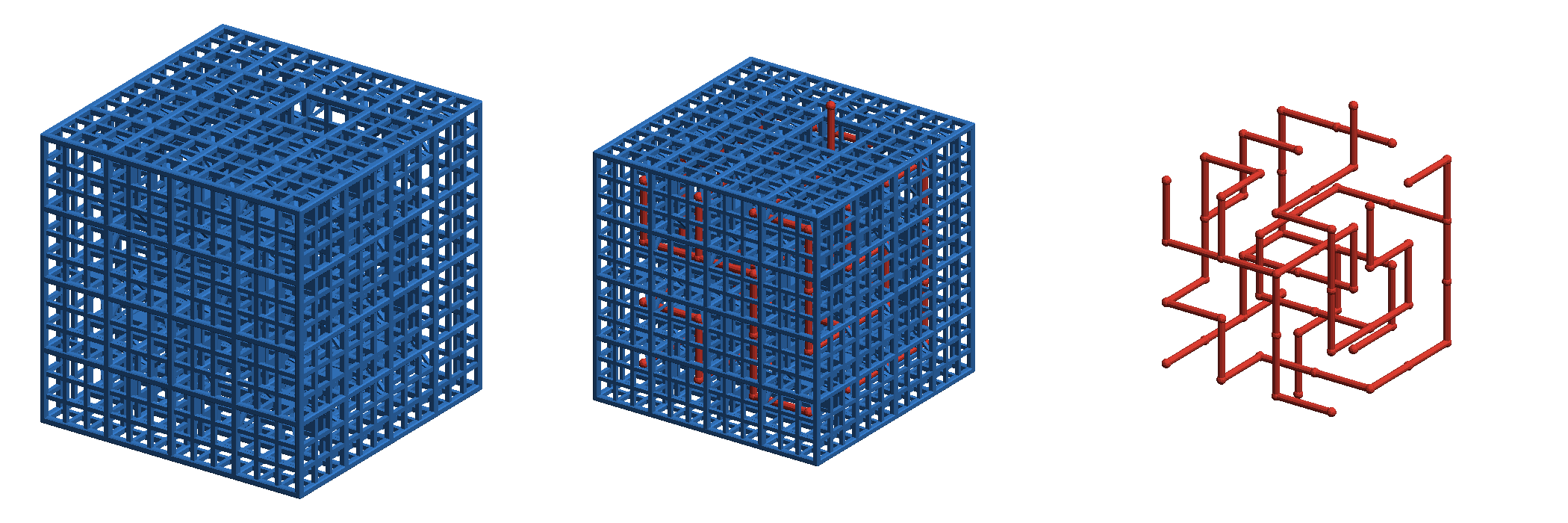
The cube is printed on a 3D printer, and its walls are little window frames, so you can see right through it. Inside rolls a ball. The cube has two openings to the outside: drop the ball into either of them and try to get it out through the other.
The only thing that moves the ball is gravity, so you turn the whole cube in your hands. Down is wherever you point it. When the way on leads upwards, the only way to follow it is to turn the maze over, and after a few turns it is surprisingly hard to say which side used to be the top. Seeing the ball all the time helps less than you would think.
Every maze has exactly one way through and no loops; every other passage ends in a dead end sooner or later. The smallest real one, three cells along each side, is a warm-up. The 4×4×4 has sixty-four cells, and the way through visits thirty-nine of them.
A knot
Imagine the way through the 4×4×4 maze as a piece of string threaded through the cube from one opening to the other. Tie its two ends together outside the cube, then take the loop out and try to straighten it into a plain ring. It cannot be done without cutting the string. The way through the maze is tied in a knot — the simplest one there is, the same as an ordinary knot in a shoelace with its ends joined.
A maze on paper can't do that. A line on a page can't pass over or under itself, so it can never be knotted. A knot needs the third dimension, and a maze in which no direction is special can use it fully. For me this is the best answer to the question the project started with: given the space, the old idea does something it never could before.
Elsewhere
- MakerWorld — the mazes ready to print, from a warm-up to the knotted ones, with the ball and printing tips.
- GitHub — how it is made. Everything, from the window frames to the mazes themselves, comes out of a small program, so a new maze is easy to make, and the program can also look for knotted ones.